Ripple · Case Study
Finding your people, made simple.
A mobile-first community-discovery tool for adults experiencing loneliness.
UX Designer & Researcher · 5 weeks · Figma + secondary research · Onboarding flow + community discovery

How I understood the problem
03
Stigma & Self-Reliance
63.8% of people cited "desire to handle the problem on one's own" as their #1 reason for not seeking support.
Source: Corrigan, WHO
02
The Treatment Gap
66% of US adults with a mental illness received no treatment in 2024. Adults 18–25 have the highest prevalence and the lowest treatment rate.
Source: NAMI, 2024
01
The Loneliness Crisis
61% of adults aged 18–25 report serious loneliness — the highest of any demographic. 81% of lonely adults also report anxiety or depression.
Source: Harvard MCC, 2021
04
Cognitive Load & Distress
People in emotional distress have measurably reduced working memory. Every unnecessary choice or form field raises the barrier to engagement at exactly the wrong moment.
Source: Sweller, Cognitive Load Theory
How might we help socially isolated adults feel like they genuinely belong somewhere?
"I'm in crisis"
"I'm fine, just a little lost"
The Ripple Zone
Ripple was built for everyone in between.
Research
Who I designed for
Personas
Jordan Kim
27 · Junior Software Developer · Seattle
"I've Googled 'support groups Seattle' like three times. Half the results are dead links."
Biggest Barrier:
Discovery gap—he knows what he wants but can't find it.
Goals:
· Find free local peer support.
· Rebuild a "somewhere to go" feeling.
Frustrations:
· Search results are outdated or broken links.
· Doesn't know what orgs exist in the city.

Maya Reyes
22 · Student & Barista · Bellevue
"I just feel alone since I moved here—but every time I look, it's all therapy and hotlines."
Biggest Barrier:
Goals:
Frustrations:
Doesn't feel "disconnected enough" to deserve help, so she doesn't reach out.
· Searches return therapy or long-term commitments.
· Can't find local community groups nearby.
· Understand what free options exist nearby.
· Feel less alone without having to explain her whole situation.

What guided every decision
Design
01
Emotion First
Prioritizing feelings over clinical labels creates a supportive atmosphere without pressure.
02
Reduce Complexity
Simplifying choices minimizes cognitive load so users can navigate confidently.
03
Respect Autonomy
No required fields, mandatory paths, or diagnoses—users browse on their own terms.
04
Privacy by Default
No public profiles, no visible activity. Privacy is a precondition for engagement.
05
"You're Allowed"
Ripple never asks users to identify as "in crisis." Everyone belongs, no qualifications needed.
First-time onboarding
Designed to collect only what's needed — no required fields.
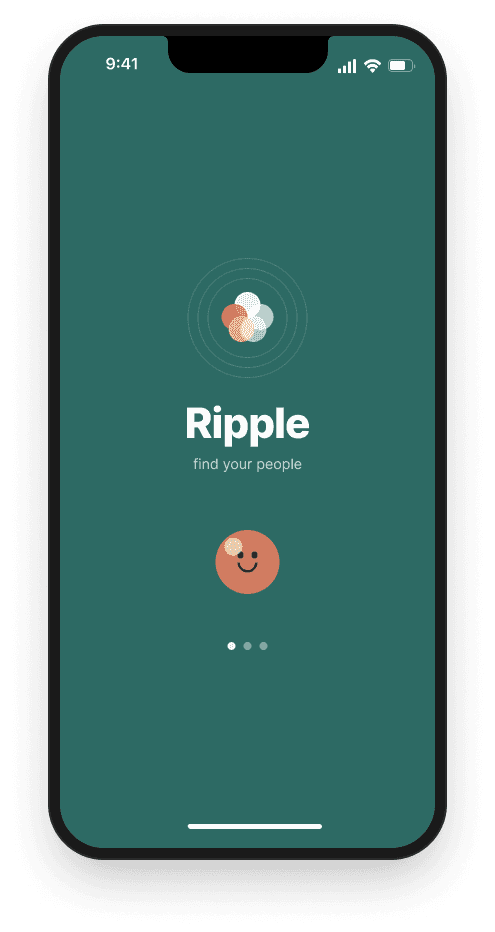
Splash / Welcome
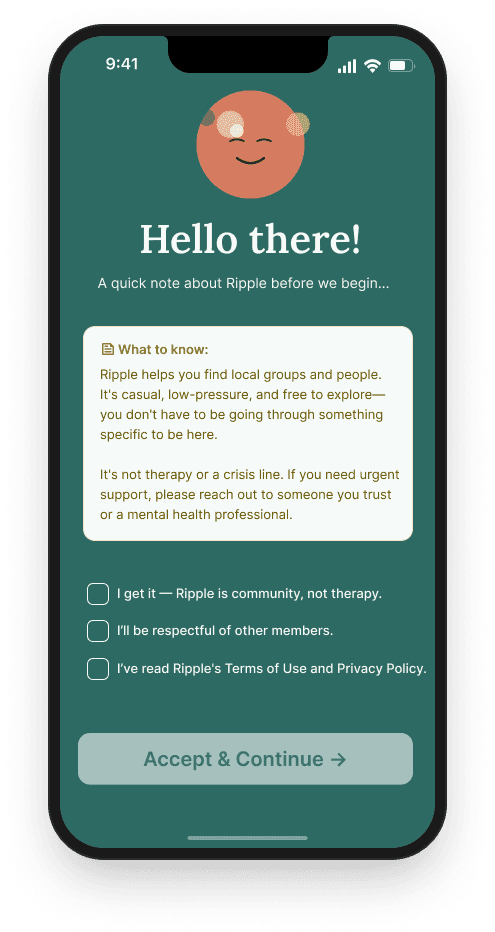
Disclaimer / Consent
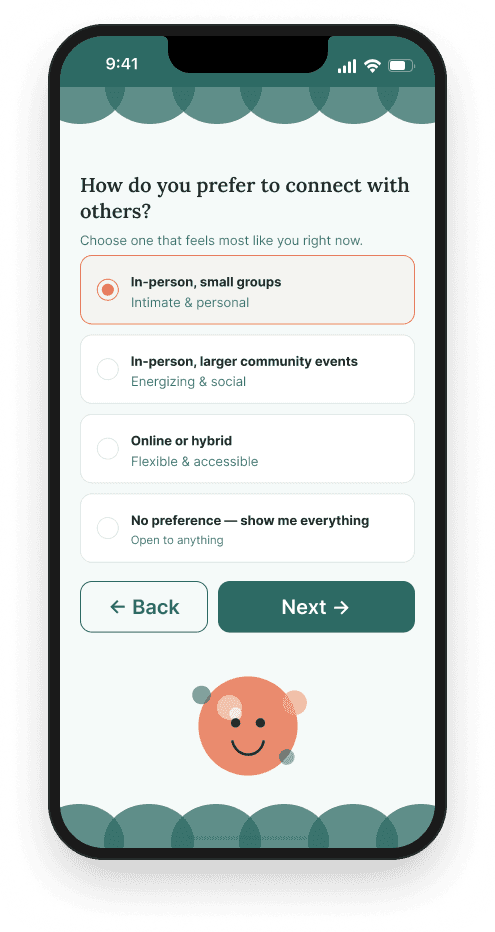
Experience Selection
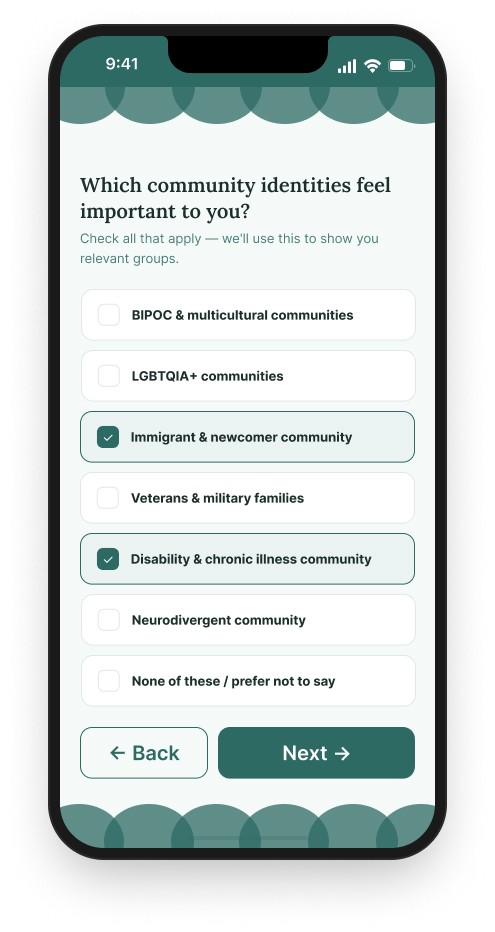
Identity / Community
Explore Feed
→
→
→
→
User opens app.
Informed consent.
Multi-select experiences.
Optional identity tags.
Personalized feed.
Skip
Skip
User Flow
Design decisions in practice
Every screen traces back to a finding.

Design Decision 01
Consent before anything else
The disclaimer explains what Ripple is—and what it isn't—in plain language before asking anything of the user. Privacy is treated as onboarding content, not fine print. Checkboxes start unchecked to avoid a consent dark pattern common in sensitive apps.
| "I just want somewhere to go." —Maya
Source: WHO autonomy barrier · Corrigan stigma research
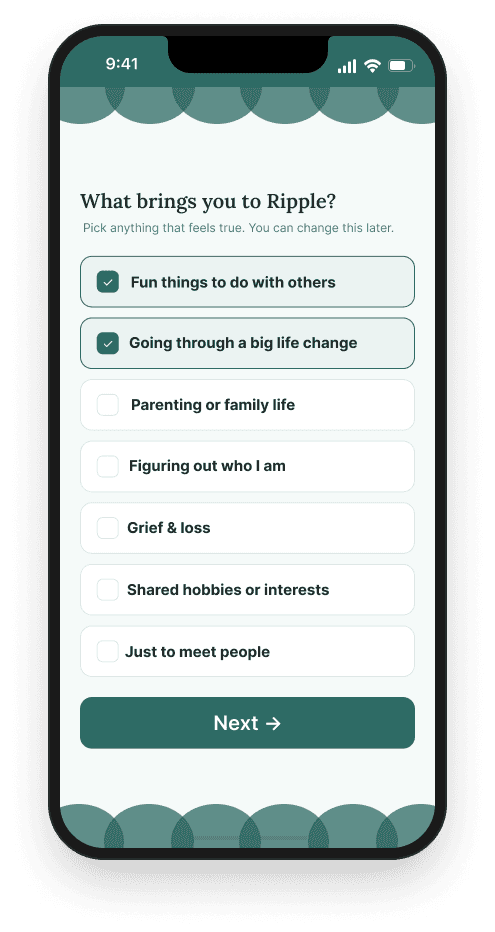
Design Decision 02
Everyday language, not clinical labels
Experience options use plain language anyone can relate to. No option implies the user is broken. Multi-select lets users define their own combination without being forced into a single category.
| "I don't want to have to explain myself just to find a group." —Maya
Source: WHO autonomy barrier · Corrigan stigma research

Design Decision 03
Trustworthy results, free by default
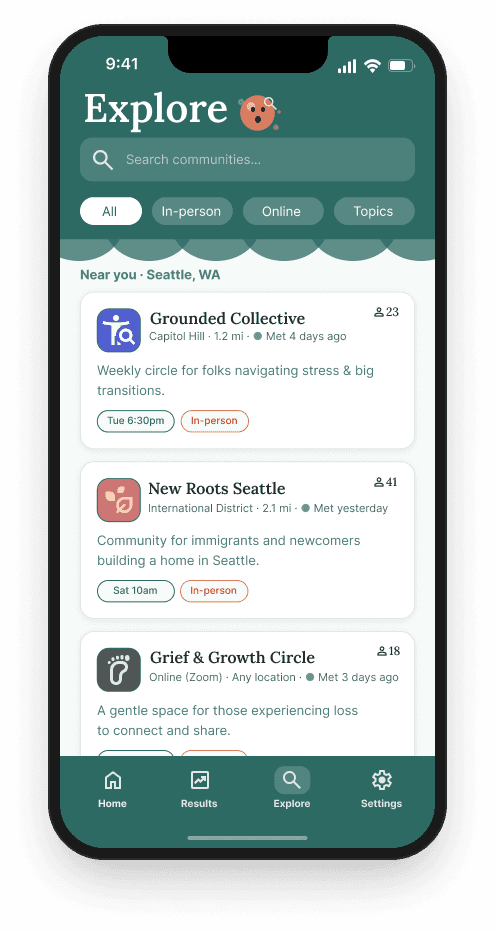
Every listing shows an "active within 30 days" badge—eliminating dead links, Jordan's #1 frustration. Cost-free resources surface first without needing a filter. Drop-in options are tagged prominently for users not ready for long-term commitments.
| "Half the results are dead links." —Jordan
Source: SAMHSA · MHA: 24.58% of distressed adults can't afford care
Design Decision 04
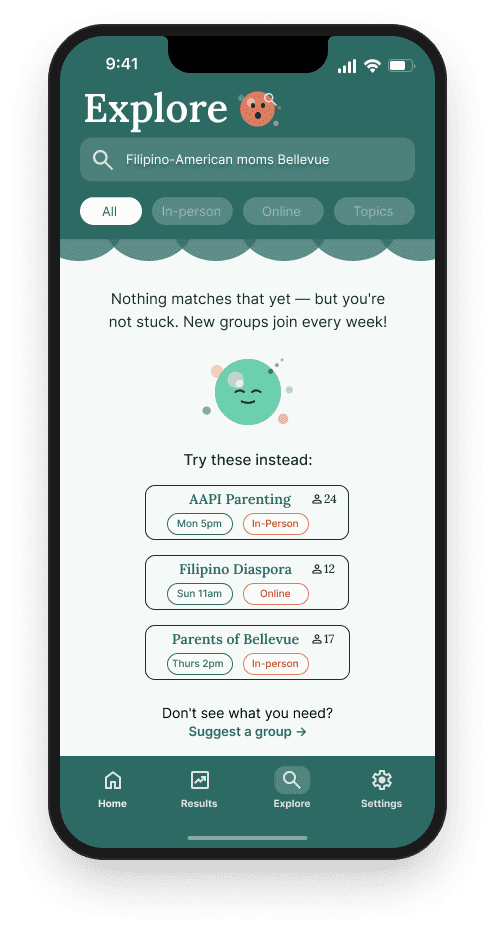
No search ever returns "nothing"
When a search yields no exact match, the screen validates the effort and immediately offers related alternatives. The copy never says "no results found"—a phrase that reads as rejection to an already isolated user.
| "It's all therapy and hotlines." —Maya
Source: Sweller Cognitive Load Theory · Harvard MCC


Welcome / Splash
Platform Preference
Identity Selection
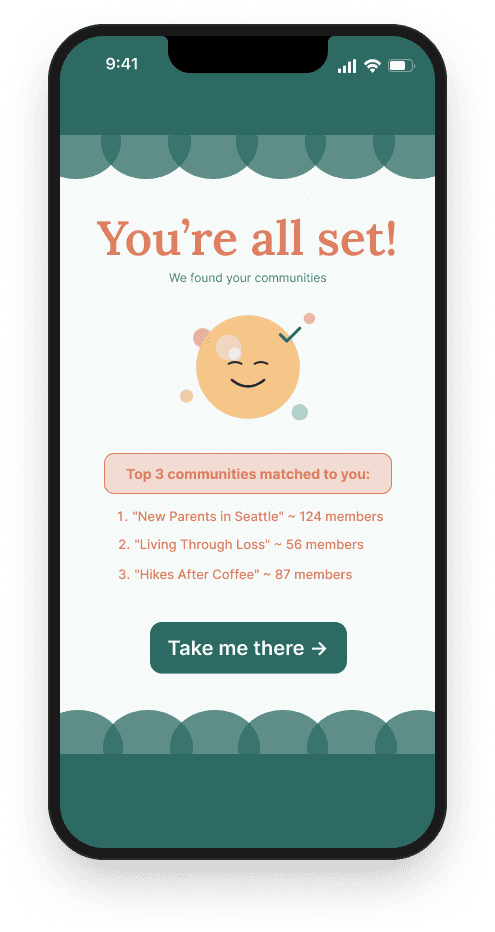
Quick Results
Process
The structure came first. The feeling came after.
Wireframe

Hi-Fi

Wireframe

Hi-Fi

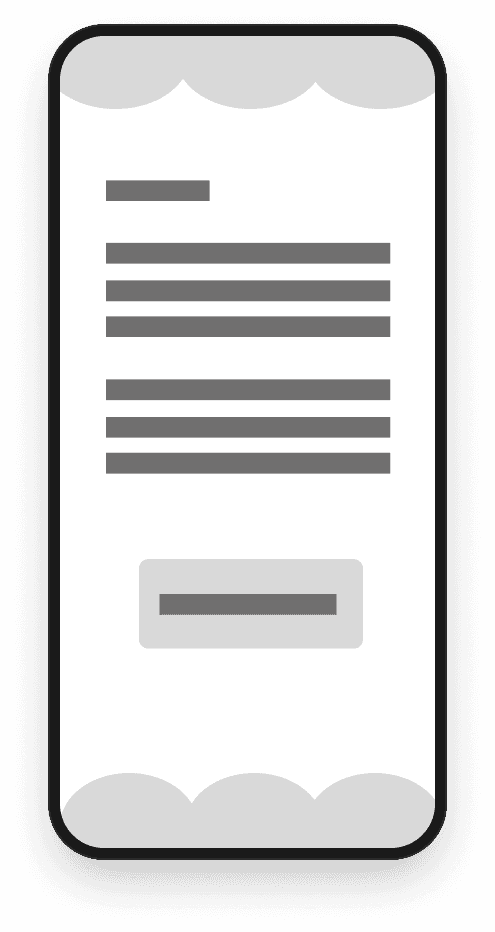
Consent evolved from a text block to an onboarding moment.
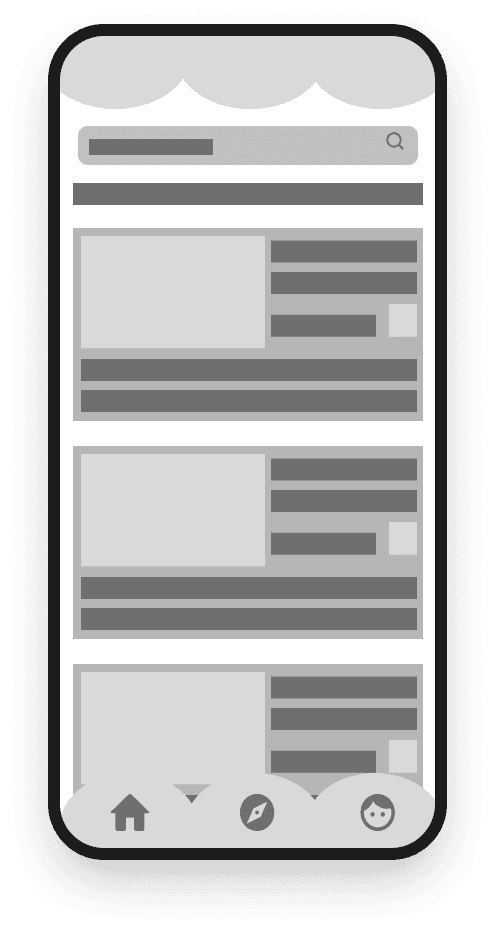
Dead gray boxes became living, active community cards.
Takeaways
What I learned, and what comes next.
How I'd test it:
I'd recruit 5–8 participants matching Jordan and Maya's profiles—adults 22–38 experiencing social isolation. Three usability tasks: complete onboarding, find one relevant community, and search for a specific interest. Success metrics: task completion rate, time-on-task, and whether users feel the language is welcoming rather than clinical.
What I'd do differently:
I underestimated how much the empty state screens matter. A user who searches and finds nothing is at their most vulnerable—I'd spend more time on those edge cases. I'd also test the Ripple Zone diagram with real users earlier; it was the hardest concept to communicate visually.
Where this goes next:
Ripple is designed for people who are already hesitant. Every untested assumption is a potential reason for someone to close the app. The next step is getting it in front of real users—specifically people who match Jordan and Maya's profiles—and finding out what breaks.