01
Stress impairs inhibitory control:
Roos et al. (2017) showed acute stress disrupts inhibitory control using a complex social stressor—but their method required judges, prepared speeches, and mental arithmetic.
Source: Roos et al., Biological Psychology (2017)
02
Stroop interference as a validated measure:
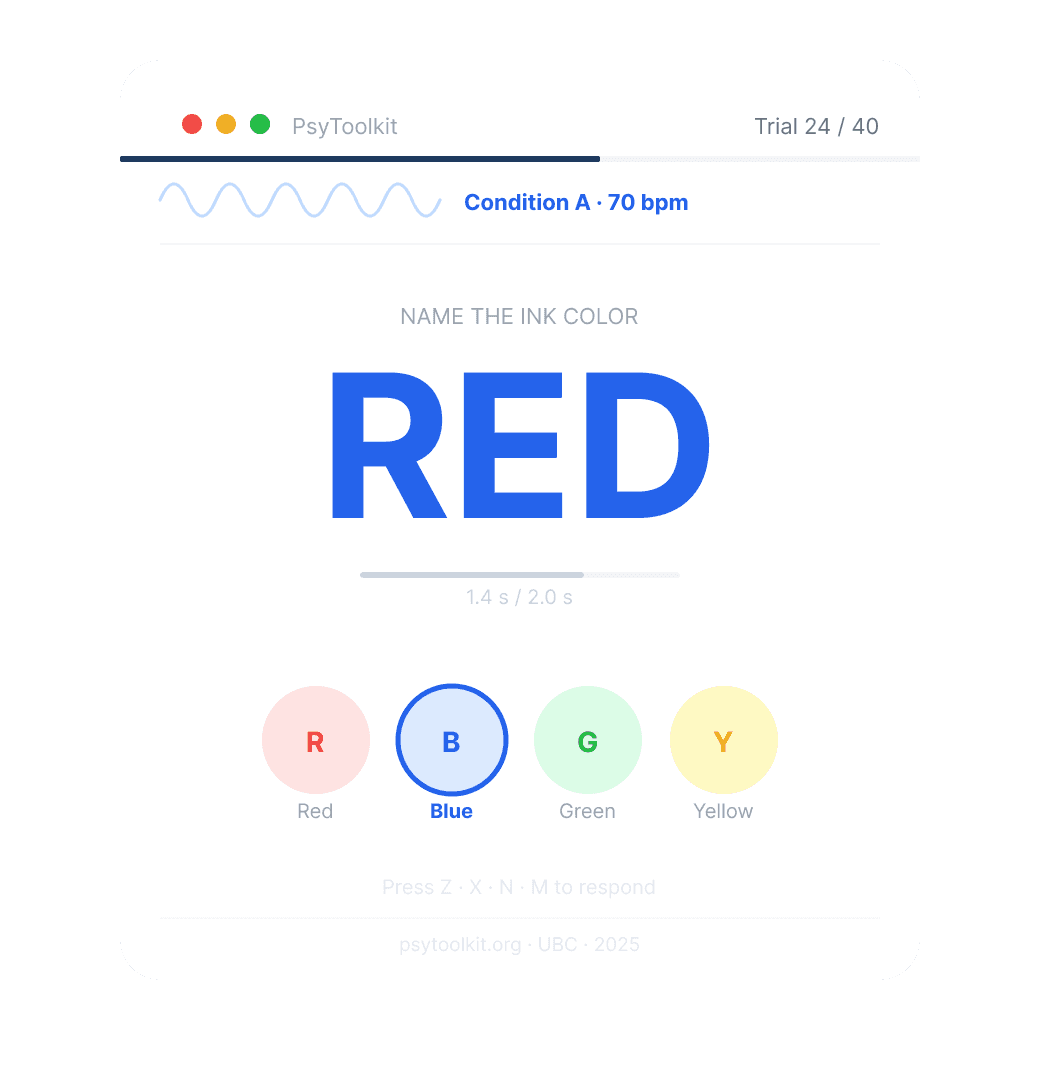
Knight & Heinrich (2017) confirmed Stroop interference in milliseconds is a reliable empirical proxy for inhibitory control—the longer the reaction time on mismatched trials, the worse the inhibitory control.
Source: Knight & Heinrich, Frontiers in Psychology (2017)
03
A simpler stressor, untested:
Source: Study rationale
Inhibitory control—our ability to block out irrelevant information—is something we rely on constantly. This study asked whether forced heavy breathing, a simple and accessible stressor, could measurably disrupt it.
Research
Design

Results
114.76 ms
Condition A — Stress group
SD = 81.66
63.08 ms
Condition B — Control group
SD = 43.81
Mean difference: 51.69 ms — the stress group was 82% slower on average.

Limitations
Every course-level study has constraints worth naming.
All participants were UBC psychology undergraduates—low demographic variety limited our external validity.
With n = 30 (15 per cell) and a result of p = .049, the study was likely underpowered. The effect size may be inflated relative to the true population effect which is a common issue with small samples that barely reach significance.
No physiological measure was taken to verify that the breathing manipulation actually induced stress—without heart rate or cortisol data, it's possible the effect was driven by discomfort or distraction rather than stress specifically.
Forced breathing may introduce confounds beyond stress (physical discomfort, hyperventilation-adjacent effects) that can't be isolated.
Takeaways
What I learned, and what comes next.
What I'd do differently:
I'd report Cohen's d alongside the t-test and also add heart rate monitoring to validate that the breathing manipulation actually elevated stress. I'd use a more demographically diverse sample—recruiting only from one PSYC course significantly limits what you can generalize.
Where this goes next:
The Stroop task is a proxy. The real question is what inhibitory control failures look like in environments designed to exploit them such as checkout flows that add fees at the last step, urgency cues that trigger mild physiological arousal, or simply buying something after a hard day. If stress reliably impairs the ability to filter misleading information, consumer vulnerability to deceptive pricing may be partly a physiological story, not just a cognitive one.
What I learned about running an experiment:
The most demanding part wasn't the analysis—it was the logistics of running controlled conditions consistently across multiple participant groups. scripted instructions, numbered chairs, synchronized timers, and per-participant codes were all necessary to maintain basic standardization.
